Tangential Flow Filtration (TFF) is a membrane-based separation method used in downstream bioprocessing, where the feed stream sweeps across the membrane surface instead of being pushed straight through it. Technical literature from life-science suppliers explains that this parallel flow lowers the chance of filter clogging and is gentler on shear-sensitive products than normal flow filtration. That combination explains why the technique has become a workhorse for purifying and concentrating biologics.
The method is also known as crossflow filtration. Reference literature explains that the tangential motion of the bulk fluid rubs trapped particles off the membrane surface. The same principles underpin reverse osmosis, nanofiltration, ultrafiltration and microfiltration. In protein purification, the TFF label is applied specifically to crossflow operation with membranes, and the step can sit at different points in a purification train depending on the membrane selected.
The engineering logic is rooted in concentration polarization, where retained species accumulate at the membrane. Patent literature on Tangential Flow Filtration systems explains that the sweeping action removes retained material and keeps flux high and stable. The same literature notes a trade-off: higher tangential velocities raise flux, so conventional practice calls for fast channel flow and high feed rates.
How does Tangential Flow Filtration Work?

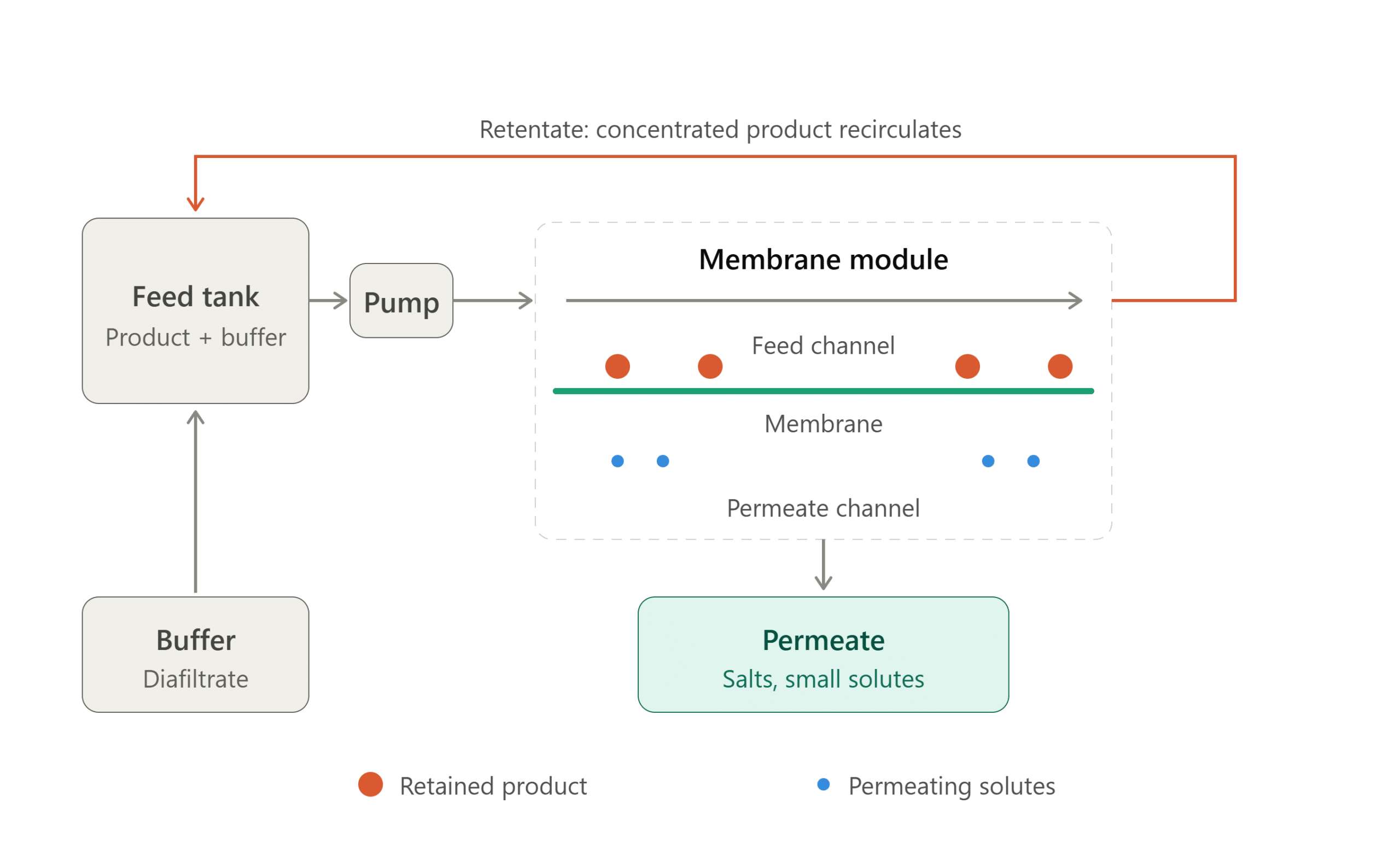
The diagram shows a closed loop. Product circulates from the feed tank through the membrane module and back, while small unwanted molecules leave as permeate. It reads left to right, with the return line running along the top.

Step-by-step walkthrough
1. Feed tank (left). The tank holds the product solution, which contains the target molecule plus buffer, salts and other small solutes. This is where the process starts and where it loops back to.
2. Pump. The pump moves the feed out of the tank and into the membrane module. It supplies the flow that makes the tangential sweeping action possible.
3. Membrane module and feed channel. Inside the dashed box, the feed travels along the membrane rather than through it. The arrow in the feed channel shows this parallel flow. The orange circles are the larger product molecules the membrane retains.
4. Membrane (green line). The membrane acts as a size-based barrier. Large product molecules cannot cross it, so the moving feed carries them along the surface. This sweeping motion is what keeps the membrane from clogging and is gentler on shear-sensitive products.
5. Permeate channel and permeate. The blue dots are small solutes, such as salts and buffer components, that do pass through the membrane. They collect in the permeate channel below and leave the system through the downward arrow into the permeate box. This removal is what concentrates the product, which is the ultrafiltration function.
6. Retentate return loop (top line). The product that stays on the feed side, called the retentate, exits the module and travels back along the top line to the feed tank. Because it returns more concentrated, each pass through the loop raises the product concentration.
7. Diafiltration buffer (bottom left). Fresh buffer is added to the feed tank from below. As permeate carries old buffer and small impurities out, the added buffer replaces the lost volume. Over time the product ends up in a new buffer, which is the diafiltration function.
Key ideas the diagram shows
| Diagram element | What it represents | Process role |
|---|---|---|
| Feed tank | Source and return point | Holds the product circulating in the loop |
| Pump | Flow driver | Creates the tangential flow across the membrane |
| Feed channel | Space above the membrane | Carries product parallel to the surface |
| Membrane | Size-selective barrier | Retains large molecules, passes small ones |
| Permeate | Stream that crosses the membrane | Removes salts and small solutes |
| Retentate loop | Return line | Recirculates and concentrates the product |
| Diafiltration buffer | Added buffer stream | Exchanges the buffer around the product |
How Tangential Flow Filtration Delivers Ultrafiltration and Diafiltration
In practice, TFF performs two jobs. Ultrafiltration raises the concentration of a molecule in solution based on its size, while diafiltration exchanges buffers. Diafiltration is like washing a filter cake to remove soluble components. These include pre-concentrating monoclonal antibodies before anion exchange chromatography, removing organic solvents during antibody-drug conjugate manufacturing, and concentrating plasmid DNA while swapping chromatography buffer for final buffer. TFF also helps raise concentration for high-viscosity drugs. Tangential Flow Filtration therefore appears at several stages of a single process, not only at final formulation.

Single-Use, Multi-Use and Single-Pass Tangential Flow Filtration Formats
Traditional TFF systems for antibodies, insulin, vaccines and recombinant proteins have been operated for reuse. Operational sources point out that reusing devices requires cleaning, validation and storage steps. These add no value to the product yet demand significant time and labor, which is the core argument for single-use alternatives.
Single-use Tangential Flow Filtration removes those steps. Operational sources report that eliminating pre-run and post-run work can shorten total process time considerably and cut the volume of purified water and caustic agents consumed. It also cautions that results vary with the specific application and process, so any savings should be confirmed for each workflow.
Single-pass TFF takes a different route. Batch TFF recirculates feed through the module repeatedly, while single-pass operation sends feed once through several modules in series, lengthening the path to reach the same volume reduction. Because feed need not return to the original tank, tankage can often be eliminated. Smaller pumps and pipes reduce hold-up volume and raise product recovery. This also makes Tangential Flow Filtration gentler for shear-sensitive molecules, since fluid is not repeatedly cycled across the membrane.
Limits, Cleaning and Alternating Flow in Tangential Flow Filtration
The technique has costs. Patent background sections describe TFF devices as needing large membrane area, high flow rates and high pressures, which may damage a desired component. They add that thorough cleaning between uses is time-consuming and expensive, which motivates disposable ultrafiltration systems with flexible system volume.
Other tools help manage fouling. Alternating tangential flow uses a diaphragm pump to create reversing flow that helps dislodge retained particles. Reference sources note that backwashing does not apply to spirally wound membranes. Process flow disruption is described as less effective than backwashing but potentially advantageous, and clean-in-place is covered as a separate operation.
Why Tangential Flow Filtration Is Moving Toward Integrated Continuous Bioprocessing
Patent literature on continuous recombinant protein production describes integrating capture chromatography, post-capture chromatography, virus filtration, and ultrafiltration and diafiltration. Its claims include ultrafiltration by single-pass Tangential Flow Filtration and single-pass diafiltration. The disclosure cites a need for integrated continuous bioprocesses that run for extended periods with minimal operator interaction.
Normal Flow Filtration vs Tangential Flow Filtration
| Attribute | Normal Flow Filtration | Tangential Flow Filtration |
|---|---|---|
| Feed direction | Pushed through the membrane | Flows parallel to the membrane |
| Clogging risk | Higher | Lower |
| Shear-sensitive products | Less suited | Gentler |
| Primary functions | Not specified in source | Ultrafiltration (concentration), diafiltration (buffer exchange) |
TFF Formats and Reported Characteristics
| Format | Key Feature | Reported Benefit |
|---|---|---|
| Batch multi-use TFF | Feed recirculated repeatedly; device reused | Established practice; needs cleaning, validation, storage |
| Single-use TFF | Pre-run and post-run steps eliminated | Shorter process time; lower fluid use |
| Single-pass TFF | One pass through modules in series | Possible tankage elimination; smaller pumps and pipes; higher recovery |
| Alternating tangential flow | Diaphragm pump reverses flow | Helps dislodge particles and limit fouling |