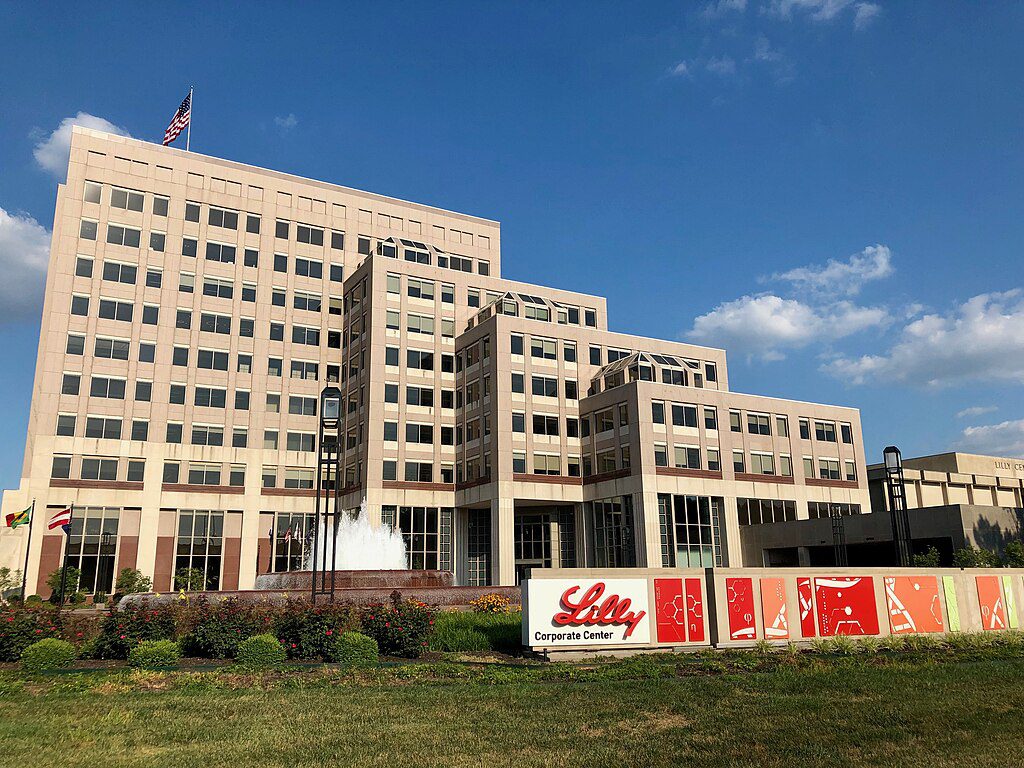
Eli Lilly and Company announced a significant partnership with NVIDIA to develop the most potent supercomputer in the pharmaceutical sector. A dedicated “AI factory” that will oversee the complete artificial intelligence lifecycle from data intake to training and large-scale inference will be powered by the new technology.
Built with DGX B300 systems, the supercomputer is the first NVIDIA DGX SuperPOD in the world and will be powered by over 1,000 B300 GPUs. According to Lilly, this new capability will leverage its “decades of data” to expedite the delivery of new medications and establish a new scientific standard.
The goal of the partnership is to revolutionise the drug discovery procedure. Researchers will be able to test possible medications by training AI models on millions of tests, greatly broadening the scope of their work. Using digital twins and NVIDIA’s robotic technology, Lilly also intends to use the supercomputer to increase production efficiency, support researchers with new “scientific AI agents,” and shorten development cycles.
Read More: Eli Lilly Reports Strong Q2 2025 Financial Results with 38% Revenue Growth
Lilly is shifting from using AI as a tool to embracing it as a scientific collaborator,
Learn MoreBy embedding intelligence into every layer of our workflows, we’re opening the door to a new kind of enterprise: one that learns, adapts and improves with every data point. This isn’t just about speed, but rather interrogating biology at scale, deepening our understanding of disease and translating that knowledge into meaningful advances for people served by Lilly medicines as well as the broader life sciences ecosystem.
Thomas Fuchs


MSD Oncology Pipeline Advances With First Phase 3 Data for Intismeran Autogene Plus KEYTRUDA and Sacituzumab Tirumotecan
The Merck oncology pipeline will present first-time Phase 3 results for intismeran autogene plus KEYTRUDA, sacituzumab tirumotecan and KEYTRUDA monotherapy in Madrid from Oct. 23-27, […]


In an effort to increase access to these cutting-edge resources throughout the biopharma ecosystem, Lilly also revealed that a number of its proprietary AI models will be made available on Lilly TuneLab, a collaborative AI drug development platform.
In keeping with its pledge to become carbon neutral by 2030, the business revealed that the supercomputer will be powered entirely by renewable energy sources within the current Lilly facilities.