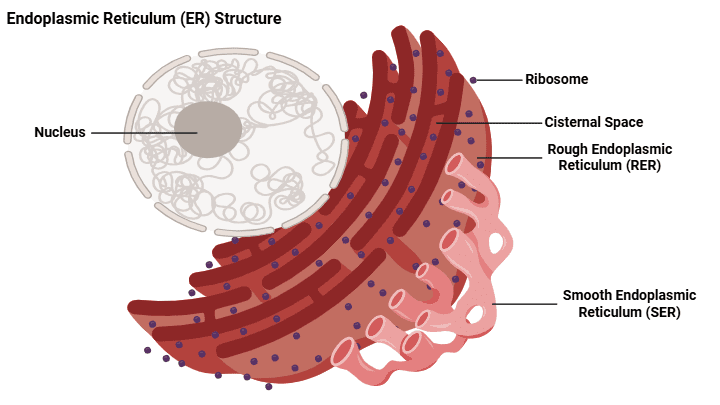
One of the most intriguing and intricate organelles in eukaryotic cells is the endoplasmic reticulum (ER), which is essential for calcium homeostasis, lipid metabolism, and cellular protein synthesis. This vast membrane network, which coordinates vital cellular functions that support life itself, is a marvel of biological engineering.
Structural Organization and Morphology
The intricate three-dimensional structure of the endoplasmic reticulum, which is made up of a continuous membrane system extending throughout the cytoplasm, is what defines it. This organelle exhibits two unique morphological regions with specialized functions, demonstrating its amazing structural diversity.
Read More: Mitochondria – The Powerhouse
Tubular Network and Cisternal Sheets
The ER is made up of thicker sheet-like areas in the perinuclear region and interconnecting small tubules at the cell periphery, all of which are attached to the nuclear envelope. The peripheral ER is a vast network of tubules and cisternae that extends from the outer nuclear membrane into the cytoplasm and ends at the plasma membrane. The morphologies of ER tubules and cisternae differ significantly; although cisternae are made up of extensive stretches of parallel flat membrane bilayers, tubules have a substantial membrane curvature at their cross-section.
Read More: Mitosis: Definition, Stages, Mechanism of Cell Division, and Diagrams
Dynamic Membrane Remodeling
Through ongoing remodeling procedures that include frequent form changes and reorganizations, the ER preserves its intricate structure. The organelle can adjust to shifting cellular needs during growth and stress reactions thanks to its dynamic nature. Its structural flexibility allows the ER to quickly adapt to the demands of cellular biosynthesis and is crucial for its variety of functional roles.
Functional Domains and Specialized Roles
Protein Synthesis
Proteins intended for secretion, membrane incorporation, or organellar targeting are mostly synthesized in the endoplasmic reticulum. Co-translational translocation of developing proteins into the ER lumen, where they go through appropriate folding and post-translational modifications, is facilitated by the rough ER, which is studded with ribosomes.
Complex protein quality control systems that guarantee correct protein folding and stop the buildup of misfolded proteins are housed in the ER. Several E3 ubiquitin ligases, including Glycoprotein 78 (Gp78), are used by these systems to selectively degrade abnormal proteins via endoplasmic reticulum-associated degradation (ERAD). The unfolded protein response (UPR), a vital stress signaling system that restores cellular homeostasis, is initiated by the ER when protein folding capacity is exceeded.
Read More: Understanding Prophase: Roles in Mitosis and Meiosis (Prophase I & II)
Lipid Metabolism and Membrane Biogenesis
The ER plays a key role in membrane biogenesis and lipid production in addition to protein processing. Lacking ribosomes, the smooth ER is the main location for phospholipid and sterol production and is specialized in lipid metabolism. In plant cells, where the ER generates essential elements for cellulose cell wall formation, this function is especially crucial.
Calcium Storage and Signaling
The ER plays a key role in membrane biogenesis and lipid production in addition to protein processing. Lacking ribosomes, the smooth ER is the main location for phospholipid and sterol production and is specialized in lipid metabolism. In plant cells, where the ER generates essential elements for cellulose cell wall formation, this function is especially crucial.
Read More: Meiosis: Definition, Stages, Mechanism, and Diagram
Inter-organellar Communication and Contact Sites
Membrane Contact Sites
The Golgi apparatus, mitochondria, peroxisomes, plasma membrane, and almost every other organelle in the cell have direct membrane contact sites with the endoplasmic reticulum. Through interactions between proteins and lipids, these ER-plasma membrane contact sites are crucial for lipid homeostasis, ion dynamics, and cell signaling.
Cellular Homeostasis
The survival of eukaryotic cells depends on the endoplasmic reticulum, which plays crucial roles in calcium regulation, lipid synthesis, and protein synthesis. Receptors, transporters, and enzymes essential to cellular function are among the roughly one-third of the cellular proteome that is synthesized by the ER. The ER in plant cells creates hormone transporters and receptors that are necessary for development and environmental reactions.
Disease Connections
Many medical diseases are caused by the disruption of ER function. Cancer, metabolic problems, and neurological diseases are all linked to ER stress and faulty protein folding. Although initially protective, the unfolded protein response can set off pathways leading to cell death when stress becomes too much. Gaining knowledge about ER malfunction might help identify possible treatment targets and illness processes.
Read More: 20 Types of Amino Acids – Details and Structure
Therapeutic Applications
New treatment approaches for disorders linked to protein misfolding, calcium dysregulation, and metabolic dysfunction are made possible by our growing understanding of ER biology. One intriguing approach to creating new therapeutics for metabolic and neurodegenerative diseases is to target ER stress pathways and protein quality control systems. One example of the complex arrangement that distinguishes eukaryotic cells is the endoplasmic reticulum. It is a vital part of life itself because of its intricate structure, wide range of uses, and crucial role in maintaining cellular homeostasis. This amazing organelle will surely unlock fresh mysteries about cellular function and dysfunction as our knowledge of ER biology grows, offering insights that improve both basic biology and human health.
Last Modified: