Eli Lilly acquisitions 2026 have reached a record pace, with the Indianapolis-based drugmaker announcing more than $20 billion in deals so far this year, according to Bloomberg data reported in late May. A later analysis from The Motley Fool put the total above $25 billion across roughly 10 transactions, seven of them announced within three months. The buying spree is funded by Mounjaro and Zepbound, the tirzepatide medicines that now anchor Lilly’s income statement.
The scale is unusual even for a company with a market capitalization near $1 trillion. Lilly’s head of oncology and business development has said his team evaluates at least 10 potential deals every week, and that several multibillion-dollar attempts have been turned down. Bloomberg describes the strategy as buying earlier-stage assets rather than established blockbusters, diversifying a pipeline that leans heavily on obesity and diabetes.
History explains the urgency. When Prozac lost patent protection in the early 2000s, Lilly struggled for about a decade to regain its footing. Management appears determined not to repeat that experience while tirzepatide revenue is surging, and the Eli Lilly acquisitions 2026 program is the clearest expression of that intent.
Eli Lilly Acquisitions 2026: A Deal-by-Deal Breakdown
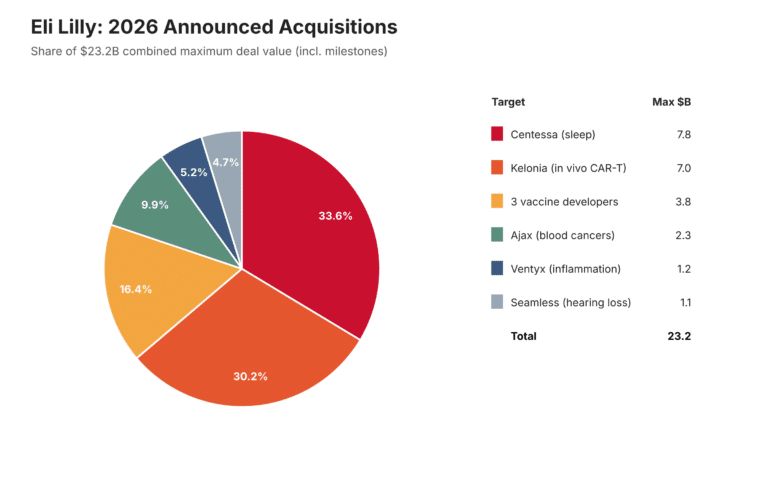
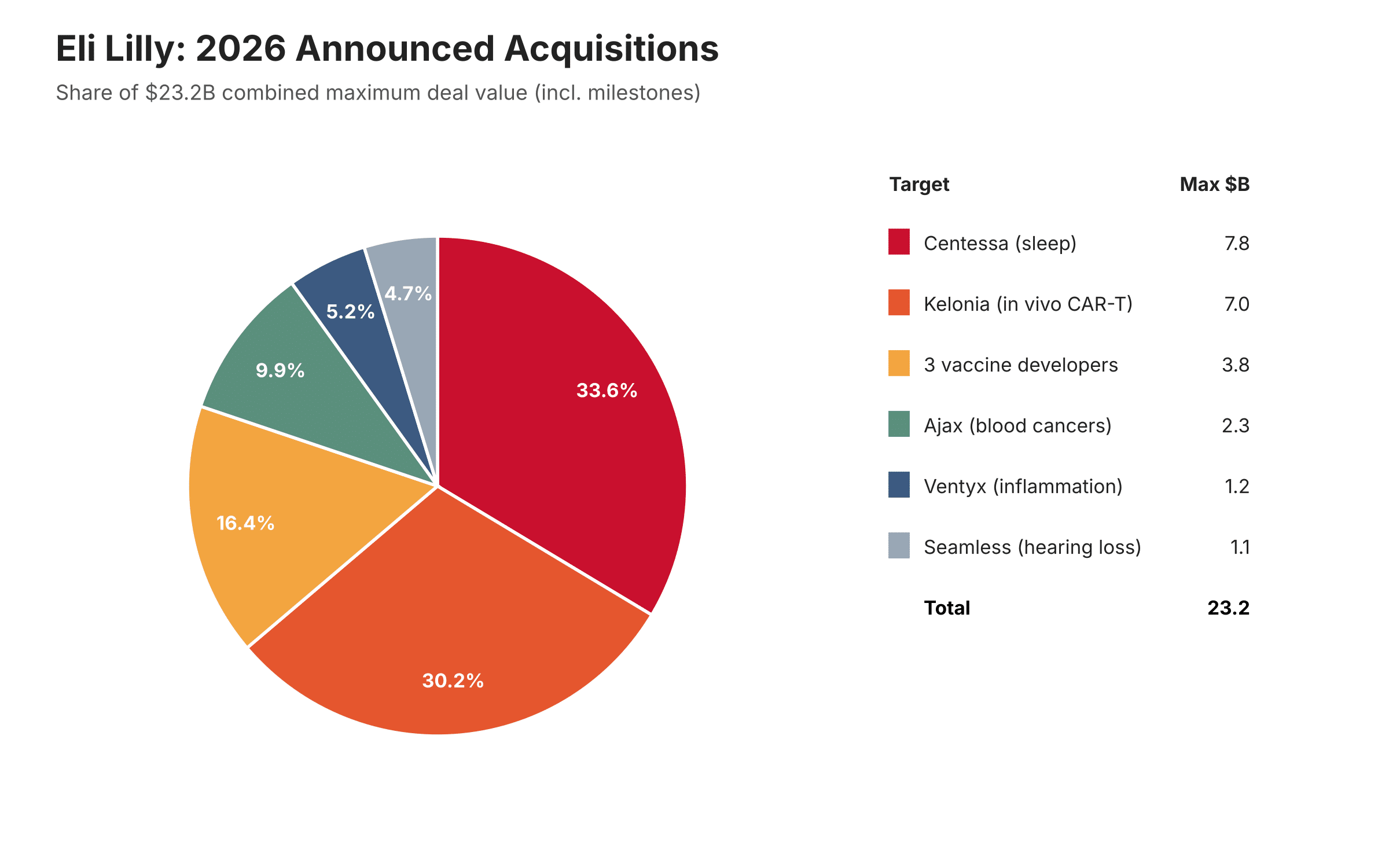
Oncology and cell therapy account for the largest share of announced value. In mid-April, Lilly agreed to acquire Kelonia Therapeutics, an in vivo CAR-T developer, for $3.3 billion upfront and up to $7 billion including milestone payments. It was Lilly’s second in vivo CAR-T acquisition of the year, following Orna. Lilly also agreed to buy Ajax Therapeutics for up to $2.3 billion including milestones, its sixth acquisition of the year at that point, to expand its blood cancer portfolio in myelofibrosis and polycythemia vera.
The largest single transaction is Centessa Pharmaceuticals, announced in late March. Lilly will pay $6.3 billion in cash upfront plus up to $1.5 billion in milestones, for a potential total of $7.8 billion. Centessa develops treatments for sleep disorders such as narcolepsy, which extends Lilly’s reach into sleep medicine.
The Eli Lilly acquisitions 2026 list also includes smaller transactions. Lilly opened the year by agreeing to buy Ventyx Biosciences, a San Diego developer of oral therapies for inflammatory diseases, in an all-cash deal of about $1.2 billion. In January it also signed a $1.1 billion agreement with Germany’s Seamless Therapeutics to develop gene therapies for hearing loss.
Eli Lilly 2026 announced deals
| Target | Therapeutic focus | Reported value | Structure |
|---|---|---|---|
| Centessa Pharmaceuticals | Sleep disorders | Up to $7.8B | $6.3B cash upfront + up to $1.5B milestones |
| Kelonia Therapeutics | In vivo CAR-T (oncology) | Up to $7.0B | $3.3B upfront, remainder milestones |
| Curevo, LimmaTech, Vaccine Company | Vaccines | Up to $3.8B combined | Cash plus milestones |
| Ajax Therapeutics | Blood cancers | Up to $2.3B | Includes milestones |
| Ventyx Biosciences | Inflammatory diseases | About $1.2B | All cash |
| Seamless Therapeutics | Hearing-loss gene therapy | $1.1B | Development agreement |
| AtaiBeckley | Treatment-resistant depression | Not disclosed | Completed in Q3 2026 |
| Merida Biosciences | Autoimmune and allergic disease | Not disclosed | Completed after Q3 quarter-end |
| Orna | In vivo CAR-T | Not disclosed | Value not found in sources reviewed |
Eli Lilly Acquisitions 2026 Return to Vaccines and Infectious Disease
On May 26, Lilly said it would acquire three vaccine developers, Curevo, LimmaTech Biologics and Vaccine Company, in deals worth up to $3.8 billion combined. Curevo shareholders could receive up to $1.5 billion. LimmaTech is valued at up to $780 million, and its lead program, LTB-SA7, is an early-stage vaccine against S. aureus, a leading cause of surgical-site infection. Vaccine Company, developing a vaccine against the Epstein-Barr virus, carries a value of up to $1.55 billion.
The trade publication pharmaphorum noted that the deals mark a return to infectious disease roughly seven years after Lilly exited the category. The package includes a potential rival to GSK’s shingles vaccine Shingrix. Analysts cited by Reuters linked the move to the October hiring of former FDA official Peter Marks as head of infectious disease, which they read as a signal of Lilly’s intent to be a vaccine innovator.
Citi analyst Geoffrey Meacham said the targets focus on viral pathogens tied to long-term neurological and oncology risks, which fits Lilly’s existing interests. Lilly’s chief scientific and product officer, Dan Skovronsky, described the strategy as preventing disease at its source rather than treating its consequences. Carnegie Investment Counsel’s Shams Afzal pointed out that the combined price is modest in the context of Lilly’s overall spending, a point that matters when judging the Eli Lilly acquisitions 2026 total.
Vaccine acquisitions announced May 26, 2026
| Company | Maximum value | Lead focus |
|---|---|---|
| Curevo | Up to $1.5B | Shingles-related vaccine (per pharmaphorum, a potential Shingrix rival) |
| LimmaTech Biologics | Up to $780M | LTB-SA7, S. aureus vaccine (early stage) |
| Vaccine Company | Up to $1.55B | Epstein-Barr virus vaccine |
| Combined | Up to $3.8B | Infectious disease prevention |
Eli Lilly Acquisitions 2026 vs Revenue: Q3 Financial Results
Lilly’s revenue explains how it can afford this pace. Third-quarter revenue rose 39% to $24.4 billion from $17.6 billion, driven by a 53% increase in volume and partly offset by a 15% decline in realized prices. Year-to-date revenue reached $67.17 billion versus $45.89 billion a year earlier, up 46%. Lilly raised its full-year 2026 revenue guidance by $5.5 billion at the midpoint, to a range of $91.0 billion to $92.0 billion. That guidance is a forward-looking estimate, not a final result.
Mounjaro generated $10.7 billion in the quarter, up 65%, while U.S. Zepbound revenue rose 48% to $5.3 billion. Gross margin was 83.9% of revenue, and research and development expense rose 23% to $4.2 billion, or 17% of revenue. In other words, Eli Lilly’s 2026 acquisitions are being financed from an exceptionally profitable core business.
The cost of buying pipeline shows up in acquired in-process research and development (IPR&D) charges. Lilly recorded $4.2 billion of acquired IPR&D in Q3 2026 versus $656 million in Q3 2025, primarily from the AtaiBeckley and Curevo acquisitions. That equaled $4.57 per share versus $0.71 a year earlier. As a result, Lilly trimmed full-year non-GAAP EPS guidance to $35.00-$36.00 from $35.50-$36.50, even though underlying performance improved by $4.07 per share at the midpoint. The Eli Lilly acquisitions 2026 program is therefore already visible in reported profit.
Lilly revenue and spending metrics
| Metric | 2026 | 2025 | Change |
|---|---|---|---|
| Q3 revenue | $24.4B | $17.6B | +39% |
| Year-to-date revenue | $67.17B | $45.89B | +46% |
| Mounjaro Q3 revenue | $10.7B | $6.5B | +65% |
| U.S. Zepbound Q3 revenue | $5.3B | Not disclosed here | +48% |
| Q3 R&D expense | $4.2B | Not disclosed here | +23% |
| Q3 acquired IPR&D charges | $4.2B | $656M | About 6x |
| Q3 acquired IPR&D per share | $4.57 | $0.71 | n/a |
| Full-year revenue guidance | $91.0-92.0B | n/a | Midpoint raised $5.5B |
| Full-year non-GAAP EPS guidance | $35.00-36.00 | n/a | Lowered from $35.50-36.50 |
What Eli Lilly Acquisitions 2026 Mean for Investors and the Pipeline
The strategic logic is diversification. Lilly reported that revenue from its key products in immunology, oncology and neuroscience grew 100% in Q3 compared with a year earlier, still a small base next to tirzepatide. Meanwhile, realized prices fell 15%, partly because Mounjaro was added to China’s National Reimbursement Drug List. Volume growth is currently outrunning price erosion, but that balance is a reason to build other revenue streams.